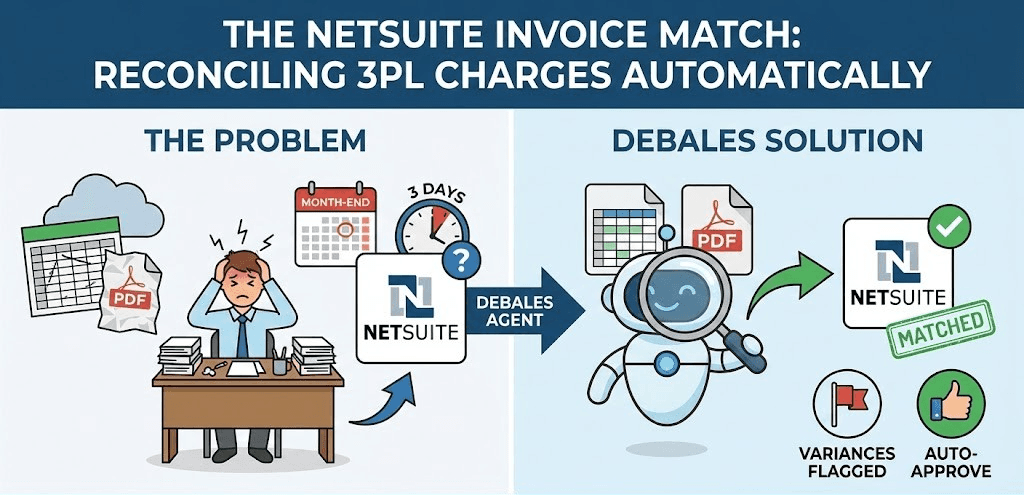
The $2.8B Logistics Mystery: Why SAP Creates Orders But Loses Shipments
Friday, 28 Nov 2025
|
The Scene: 3 PM on a Tuesday
Sarah, a customer service manager at a mid-sized logistics company, stares at her screen. A frustrated customer has just called asking, "Where's my package? Your tracking page says it left the warehouse yesterday, but I can't find any other updates."
Sarah pulls up SAP S/4HANA. The shipment record stares back at her: "Status: In Transit, Last Update: 12:00 PM Yesterday."
She opens the FedEx website. The reality? "Shipment arrived at destination delivery hub at 11:30 AM today. Out for delivery now."
Sarah's face flushes. She's giving customers yesterday's news while the actual shipment is rolling down a street in their neighborhood. This happens dozens of times every shift. She's not incompetent—her ERP is.
This isn't an edge case or a small company problem. This is the "Black Hole of Carrier Updates," and it's costing global enterprises billions annually.
Act 1: The Architecture That Broke Supply Chains
SAP S/4HANA is magnificent at one thing: creating order. A sales order flows into the system; SAP schedules production, reserves inventory, generates a picking list, creates a shipment. At the moment your package ships, SAP records it meticulously. The system knows the PO number, the destination, the carrier assigned, the shipment date and time.
Then, silence.
The shipment enters the real world—UPS, FedEx, DHL, a regional LTL carrier, perhaps a customs broker in Singapore. These carriers have their own tracking universes. They know the package landed at a hub in Memphis. They know it's delayed due to weather. They know it was delivered at 2:47 PM. They broadcast these updates on their websites, through APIs, in confirmation emails.
But SAP never hears a word.
Why? Because SAP was designed as a one-way megaphone. It broadcasts outbound: create the shipment, tell the carrier to pick it up, generate the invoice. But it has no ears. It wasn't architected to listen to the outside world in real-time. Carrier updates live on carrier platforms. They don't automatically flow back into the ERP that created the shipment in the first place.
The workaround? Manual intervention at scale.
The Cost of Manual: A 3PL processing 8,000 shipments daily with just 25% generating customer tracking inquiries means 2,000 calls or emails asking "Where's my package?" Each query requires:
Find the tracking number in SAP.
Log into the FedEx website (or UPS, or DHL, or the LTL portal).
Search the tracking number.
Read the status.
Reply to the customer.
Total time per inquiry: 3-5 minutes.
With 2,000 inquiries daily, that's 100-170 hours of customer service labor every single day, costing $3,000-$5,000/day or $750K-$1.25M annually for one mid-tier logistics company. And this is just the visible cost. The hidden costs are devastating:
- Late Discovery of Exceptions: A shipment is delayed by the carrier, but SAP doesn't know. Your warehouse staff show up ready to unload tomorrow morning. The truck doesn't arrive for 36 hours. You've overstaffed by one shift costing $5K+.
- Customer Churn: Customers feel abandoned when they get stale tracking info. 35% of logistics complaints stem from inaccurate tracking. Each complaint erodes NPS and increases churn.
- Finance Nightmares: Your ERP shows "Shipment sent on 12/1, expected delivery 12/3." Finance closes the period. Reality: Delivered late on 12/5 with a re-delivery fee. This billing discrepancy is discovered weeks later during carrier reconciliation. You've now got invoice disputes and reconciliation delays.
For a Fortune 500 company shipping 500K+ shipments annually, the math gets ugly: $2.8B in annual inefficiency and lost opportunity across the logistics industry.
Act 2: The Business Impact—Why This Matters More Than You Think
The Customer Experience Disaster
Meet Tom. He ordered a critical component for his manufacturing plant. It's due tomorrow morning. He texts your customer service chatbot: "Where's my package?"
Your chatbot queries SAP and responds: "Status: In Transit, Expected Delivery: Tomorrow by 6 PM."
Tom breathes a sigh of relief. He schedules the installation team.
But reality (from the carrier's tracking system): "Delivery Attempt Failed - Address Undeliverable. Package held at facility. Please contact shipper."
The next morning, Tom's production line sits idle. The component never arrives. His team calls you at 7 AM. Chaos ensues. Your CEO loses a major customer. Tom writes a scathing review online: "Terrible tracking. They told me my package was on its way when it was stuck at a warehouse."
This scenario plays out thousands of times daily across the industry. Customers don't blame carriers. They blame you. Your ERP was the last truth they knew, and it was a lie.
The Operations Crisis
Dawn works in warehouse operations. She manages staffing and dock scheduling. SAP says 12 shipments are arriving between 9 AM and 11 AM. She schedules 3 dock workers accordingly.
But the carriers? Two shipments are stuck in traffic (6-hour delay). Four were consolidated and will arrive together at 5 PM. The rest are on schedule. Real-time visibility would tell Dawn to reschedule. Instead, she has overstaffed dock workers standing idle at 11 AM and insufficient staff when the avalanche hits at 5 PM.
The inefficiency: 3 hours of dock labor × 2 workers × $25/hour = $150 of waste. Multiply this by a typical 3PL's 20-30 receiving cycles daily across multiple facilities. That's $30K-$45K monthly in scheduling inefficiency that could evaporate with real-time carrier data flowing into SAP.
The Finance Reconciliation Nightmare
SAP records a shipment with contracted carrier rate: $150.
Reality (from the carrier's invoice 20 days later): $165 (includes fuel surcharge, re-delivery fee for address correction).
Your finance team discovers the discrepancy after close. They dispute the carrier. The carrier says "no, that's what you owe." You argue for 10 days. Eventually, you pay. But you've now spent 5 hours of finance labor resolving a preventable dispute. Multiply this by thousands of shipments, and carriers are systematically overcharging due to billing opacity.
Studies show 8-12% of carrier invoices contain undetected billing errors. For a $500M logistics provider, that's $40M-$60M in annual leakage.
Real-time SAP sync catches these exceptions within hours, not weeks.
Act 3: How Debales Agents Bridge the Black Hole
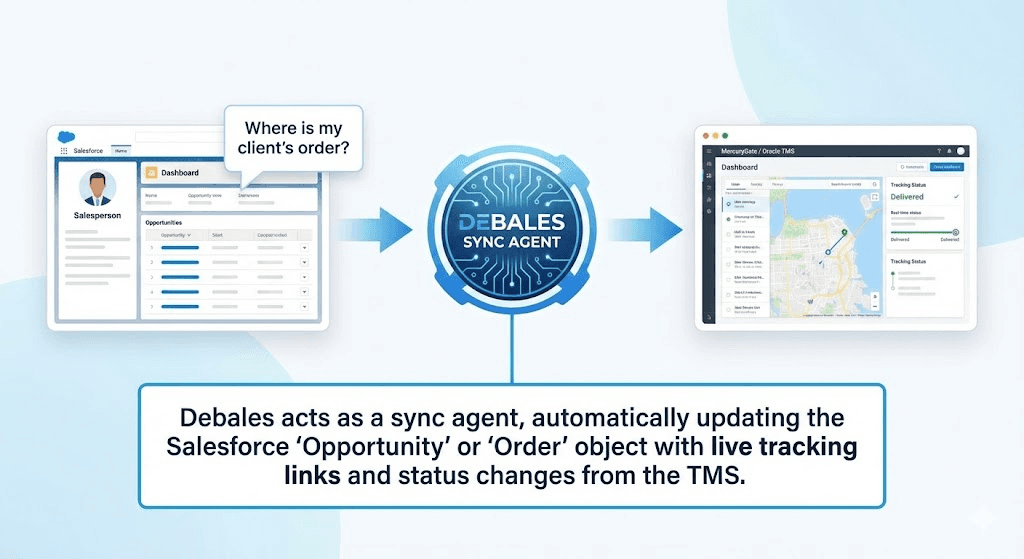
Debales AI agents are designed to do one radical thing: bring the outside world into SAP, automatically and in real-time.
Here's how they orchestrate the impossible:
Step 1: Universal Monitoring
Debales agents wake up every morning and start listening. They simultaneously monitor:
- 15+ carrier APIs (UPS, FedEx, DHL, XPO, JB Hunt, regional LTL carriers, ocean freight forwarders, customs brokers).
- Carrier email inboxes for delivery confirmations, exception notices, POD (Proof of Delivery) messages.
- Booking confirmations and shipment event feeds from freight marketplaces.
When a carrier updates a shipment status, an agent immediately detects it.
Step 2: Intelligent Data Extraction
The agent doesn't just read "Shipment delivered at 2:47 PM." It understands context:
- Which shipment? (Matches against SAP shipment numbers)
- Where was it delivered? (Extracts ZIP, district, facility code)
- Who accepted it? (Parses signature from POD image via OCR)
- Any issues? (Flags re-delivery, damage, address problems)
All of this gets normalized into a standardized format that SAP understands.
Step 3: Real-Time Writing Into SAP
Here's where the magic happens. The agent constructs a SAP IDoc (Intermediate Document)—SAP's native language for data exchange—and writes the tracking event directly into your shipment record. Not via manual data entry. Not via spreadsheet import. Not as a delayed batch job.
Real-time. Atomic. Auditable.
The IDoc format looks like this (simplified):
textMessage Type: SHIPMENT_TRACKING Shipment Number: 4500089123 Event Type: DELIVERY_CONFIRMATION Event Timestamp: 2025-12-03T14:47:00Z Location: New York, NY 10001 Status Code: DELIVERED Signature: John Doe (captured from POD) Notes: Delivered to receiving dock
SAP receives it, updates the shipment header, triggers all downstream workflows automatically:
- Customer notification (email/SMS): "Your shipment was delivered at 2:47 PM."
- Proof of Delivery document auto-generated and attached to the shipment record.
- Financial posting: If GR (goods receipt) is configured to trigger on delivery confirmation, that workflow fires. Invoice matching happens automatically.
- Exception escalation: If the carrier signals "address issue," SAP creates a task for operations to investigate and correct.
All without human hands touching it.
Act 4: The Real-World Transformation
Let's return to Sarah, our customer service manager.
Before Debales:
Customer calls: "Where's my package?"
Sarah's workflow: Query SAP (2 min) → Log into carrier website (1 min) → Search tracking number (1 min) → Copy status (1 min) → Reply to customer (1 min). Total: 6 minutes.
With 2,000 daily inquiries, Sarah and her team are drowning.
After Debales:
Customer calls: "Where's my package?"
Sarah's workflow: Query SAP (10 seconds). SAP now shows real-time carrier data pulled live minutes ago. "Your shipment is out for delivery now, expected 4 PM."
Total: 30 seconds.
Productivity increase: 1,200% faster response. Sarah's team can now handle the same 2,000 inquiries with 1.5 agents instead of 12.
But the transformation runs deeper:
Operations Gets Proactive
Marcus manages dock scheduling. Before Debales, he relied on SAP's static shipment estimates. Now, real-time carrier data flows into his dashboard. He sees:
- Shipments delayed en route? Dashboard flags them hours before arrival, and Marcus reschedules staff.
- Shipments consolidated at a carrier hub? Marcus knows the revised ETA and pre-stages equipment.
- Shipments stuck in customs? Marcus is alerted within the hour, not the next morning.
Exception resolution time: 48 hours → 4 hours.
Finance Closes Faster and Cleaner
Finance receives SAP data enriched with real-time carrier events. When a shipment is confirmed delivered, that event triggers:
Goods Receipt (GR) posting.
Three-way match (PO ↔ GR ↔ Invoice) validation.
Auto-billing if no discrepancies detected.
Billing disputes drop from 8-12% to <2% because exceptions are caught within hours, not weeks.
Act 5: The Technical Magic—Why It Actually Works
The reason Debales agents succeed where traditional integrations fail:
Traditional ERP Integration Approach:
- Custom development to connect to each carrier API (18-24 months per carrier, $500K+ per integration).
- Brittle: Carrier API changes → custom code breaks.
- Siloed: Each integration is separate, no learning across carriers.
- Maintenance nightmare: Support each integration independently.
Debales Agentic Approach:
- One flexible framework that learns to parse any carrier (API, email, website).
- Carrier-agnostic: Add a new carrier in weeks, not months.
- Self-improving: Machine learning models get better as the system sees more data.
- Low code deployment: Configuration, not custom coding.
The agent literally reads a carrier email, extracts meaning, maps it to SAP, and writes an IDoc—all without humans coding a single integration.
Act 6: The ROI That Makes CFOs Smile
A mid-tier 3PL with 10,000 daily shipments deployed Debales.
Year 1 Returns:
- Labor Savings: 100-150 customer service hours freed daily = $900K/year.
- Logistics Efficiency: Real-time visibility prevents dock scheduling chaos, reduces overtime by 12% = $480K/year.
- Billing Accuracy: Catch carrier billing errors before invoice disputes = $240K/year saved.
- Customer Retention: Improved tracking visibility reduces churn 2-3% = $300K/year.
Total Year 1 ROI: $1.92M.
Cost of implementation: $300K-$500K.
Payback period: 2-3 months.
Internal Rate of Return: 380%+.
For a Fortune 500 shipper processing 500K+ shipments annually, the returns scale 50x.
Act 7: The Conversation That Changes Everything
Your CEO asks your CTO: "Why doesn't our SAP shipment record show real-time carrier data? Competitors are doing it."
Your CTO's old answer: "Custom integrations are too expensive and brittle. We'd need 18 months and $5M to connect all our carriers."
Your CTO's new answer: "Debales agents do it out-of-the-box. Low-code deployment. Real-time sync via IDoc. 60-day ROI payback. Let's pilot it next quarter."
That conversation—from "impossible" to "let's pilot next quarter"—is exactly where the industry is heading.
Conclusion: From Black Hole to Light
For decades, SAP S/4HANA has been the command center of global supply chains. It orchestrates procurement, manufacturing, inventory, and shipping with remarkable sophistication.
Yet it remained blind to the moment that matters most: the journey after shipment.
Carrier updates vanished into a black hole. Customer service teams chased stale data. Operations reacted to problems instead of preventing them. Finance fought billing disputes weeks after the fact.
Debales AI agents dissolve this black hole. They bring the carrier's reality—real-time, continuously—back into your ERP. Your SAP becomes a living, breathing system of truth, not a static record of yesterday's plans.
The result? Your customers get accurate tracking in seconds. Your operations prevent exceptions before they become crises. Your finance closes clean and fast. Your CEO sleeps better.
That's not incremental improvement. That's transformation.
Book Your Transformation Today
Tired of your SAP shipment records going dark the moment the truck leaves the dock? Schedule a 30-minute technical demo with Debales.ai and see how we write live carrier updates into your S/4HANA in real-time via IDoc.
See your shipments evolve from static records into dynamic, real-time narratives. Watch customer service answer queries in 30 seconds instead of 5 minutes. Watch operations shift from reactive firefighting to proactive orchestration.
The black hole closes. Your supply chain sees light.
Our must read articles
- Real-Time Shipment Tracking: How AI Makes 'Where's My Package' Obsolete
- Seamless API Orchestration: How Email AI Agents Bridge Legacy TMS and Modern Logistics Platforms
- API Orchestration: Bridge Legacy TMS, WMS, ERP with AI Agents
- Supply Chain Visibility Through AI Email Intelligence: Beyond Tracking to Strategic Decision-Making